In today’s fast-paced retail environment, execution often takes center stage. Shelves are stocked, displays are refreshed, and promotions are rolled out with precision. While flawless execution is important, many retailers fall into the trap of believing that execution alone drives success. Over-focusing on execution without a strong strategic foundation can limit growth, reduce efficiency, and weaken the overall customer experience.
Execution Without Strategy Is Just Activity
Retailers frequently prioritize getting products on shelves quickly and maintaining compliance across stores. However, without a clear strategy behind these actions, execution becomes routine rather than impactful.
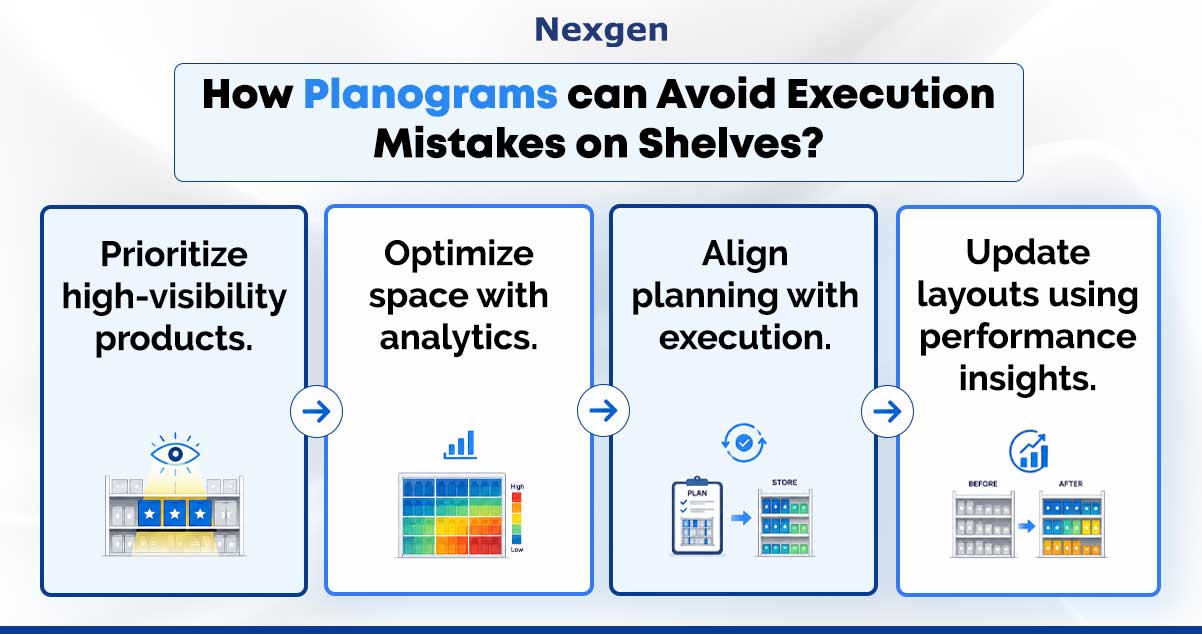
Simply placing products on shelves does not guarantee visibility, engagement, or sales. A well-defined planogram strategy answers key question:
- Which products deserve prime shelf space?
- How should categories be arranged to influence shopper decisions?
- What role does each product play in driving revenue?
- Without these insights, execution becomes guesswork.
The Missing Link: Shopper Understanding
Retail success is no longer about stocking shelves – it is about understanding shopper behavior. When retailers focus only on execution, they often ignore how customers navigate stores, what catches their attention, and what drives their purchase decisions. Shopper-centric planning ensures that:
- High-demand products at eye level.
- Complementary items grouped together.
- Layouts that guide customer flow.
- Insight-driven execution to avoid missed opportunities.
Data-Driven Decisions Matter More Than Ever
Modern retail generates vast amounts of data, from sales performance to foot traffic patterns. Retailers who focus only on execution often fail to leverage this data effectively. Strategic retailers use data to:
- Optimize shelf space allocation.
- Identify slow-moving products.
- Adjust assortments based on demand.
When execution is backed by data, every shelf becomes a high-performing asset rather than just a storage space.
Inconsistent Experiences Across Stores
Another challenge with execution-heavy approaches is inconsistency. Without centralized planning, different stores may implement layouts differently, leading to a fragmented brand experience. Planograms and structured merchandising strategies help ensure:
- Consistency across multiple locations.
- Better compliance and easier execution.
- A unified shopping experience for customers.
This balance between planning and execution is what drives scalable retail success.
Execution Alone Does Not Maximize ROI
Retail space is valuable, and every inch should contribute to revenue. When execution is not guided by strategy, retailers risk underutilizing their space. Strategic merchandising ensures that:
- High-performing products get optimal placement.
- Seasonal and promotional items are highlighted effectively.
- Shelf space aligns with business goals.
This approach directly impacts sales per square foot and overall profitability.
Overview of Nexgen POG
Nexgen POG is a robust and user-friendly cloud-based visual merchandising tool. It is designed for quick and efficient planogramming with minimal effort. Planograms in retail can be designed by easily dragging and dropping the products. AI-driven autofill capabilities can automatically arrange products based on predefined rules, category roles, and sales data, significantly reducing the time required to build accurate and high-performing planograms. The multi-device compatibility feature of POG allows you to obtain, share and edit on any device, including your phone. It helps in designing store-specific planograms for increased product visibility and sales.
Get Your Free Trial Today!