Summer is a peak shopping season for retailers, with increased demand for beverages, snacks, travel essentials, sunscreen, outdoor products, and seasonal promotions. As customer preferences shift quickly, retailers must ensure that their shelf space is allocated efficiently to maximize sales and improve the shopping experience. Traditional merchandising methods often rely on manual planning, which can be time-consuming and less responsive to changing trends. AI-powered planogram helps retailers make data-driven decisions by optimizing product placement, shelf allocation, and inventory management.
This blog explores five practical summer merchandising tips that use AI to optimize shelf space, improve product visibility, and maximize seasonal sales.
Why AI Matters for Summer Merchandising
Summer shopping patterns change rapidly due to holidays, travel seasons, weather conditions, and promotional events. AI enables retailers to analyze large volumes of sales and inventory data to make faster merchandising decisions. Key advantages of ai planogram include:
- Better shelf space utilization.
- Improved product availability.
- Accurate demand forecasting.
- Reduced stock-outs.
- Higher merchandising efficiency.
- Improved customer satisfaction.
By using AI-powered merchandising, retailers can respond quickly to changing consumer demand throughout the summer season.
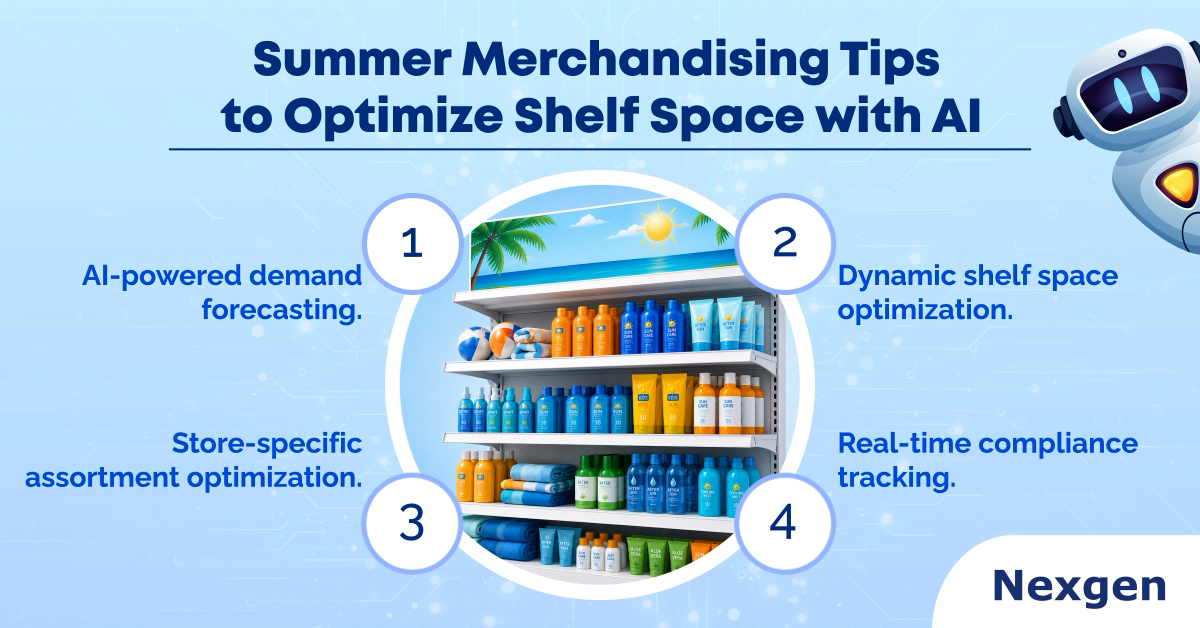
5 Summer Merchandising Tips to Optimize Shelf Space with AI
1. Prioritize High-Demand Seasonal Products
AI analyzes historical sales data, customer buying patterns, and seasonal trends to identify products with the highest summer demand. Retailers can allocate additional shelf space to fast-moving products while reducing space for slower-selling items. Popular summer products often include:
- Cold beverages.
- Sunscreen and skincare products.
- Picnic and barbecue essentials.
- Travel accessories.
- Ice cream and frozen treats.
Giving these products greater visibility improves availability and increases sales opportunities.
2. Optimize Product Placement with AI Insights
Product placement has a significant impact on purchasing behavior. AI evaluates shopper behavior, category performance, and sales trends to recommend the most effective product locations throughout the store. Retailers can use AI to:
- Place high-margin products at eye level.
- Feature seasonal items on end-cap displays.
- Cross-merchandise complementary products.
- Position impulse-buy products near checkout counters.
Strategic placement improves product visibility while encouraging customers to purchase additional items.
3. Adjust Shelf Space Based on Real-Time Demand
Customer demand during summer can change quickly because of weather conditions, holidays, and local events. AI continuously monitors sales and inventory data, allowing retailers to adjust shelf space whenever demand shifts. AI helps retailers:
- Increase facings for fast-selling products.
- Reduce space for slow-moving inventory.
- Minimize out-of-stock situations.
- Improve inventory utilization.
Dynamic shelf allocation keeps stores responsive to changing customer needs throughout the season.
4. Automate Seasonal Planogram Creation
Building seasonal planograms manually for multiple stores requires considerable time and effort. AI-powered planogram generates optimized shelf layouts using product dimensions, store fixtures, inventory levels, and category performance. Automation helps retailers:
- Save planning time.
- Maintain consistent layouts across stores.
- Quickly update seasonal displays.
- Improve merchandising efficiency.
This enables merchandising teams to spend more time on strategic planning instead of repetitive manual tasks.
5. Improve Shelf Compliance
A well-designed planogram only delivers results when executed correctly. AI-powered shelf compliance solutions verify whether products are displayed according to planograms by identifying misplaced products, empty shelves, and stock gaps. Benefits include:
- Improved planogram execution.
- Reduced stock-outs.
- Better product availability.
- Consistent merchandising across locations.
- Enhanced customer satisfaction.
Maintaining shelf compliance ensures that seasonal merchandising strategies achieve their intended results.
Overview of Nexgen POG
Nexgen POG is a robust and user-friendly cloud-based visual merchandising tool. It is designed for quick and efficient planogramming with minimal effort. Planograms in retail can be designed by easily dragging and dropping products. AI-driven Autofill capabilities can automatically arrange products based on predefined rules, category roles, and sales data, significantly reducing the time required to build accurate and high-performing planograms.
The multi-device compatibility feature of POG allows users to obtain, share, and edit planograms on any device, including mobile phones. It helps in designing store-specific planograms for increased product visibility and sales.
Get Your Free Trial Today!
FAQ
1. Why is AI useful for summer merchandising?
AI helps retailers analyze customer demand, optimize shelf layouts, automate planograms, and improve inventory management for seasonal products.
2. What products should receive more shelf space during summer?
Products such as beverages, sunscreen, snacks, travel accessories, frozen foods, and outdoor essentials typically require increased shelf space during the summer season.
3. How do AI-powered planograms improve shelf utilization?
AI-powered planograms recommend the best product placement and shelf allocation based on sales data, shopper behavior, and inventory performance, helping retailers maximize every shelf.
4. Can AI help reduce out-of-stock situations?
Yes. AI monitors inventory levels and sales trends in real time, allowing retailers to adjust shelf space and replenish high-demand products before stock-outs occur.
5. How does Nexgen POG support AI-driven summer merchandising?
Nexgen POG uses AI-powered planogram automation to optimize shelf space, improve shelf compliance, automate seasonal layouts, and help retailers make data-driven merchandising decisions.