Retailers today operate across a wide range of store formats, from large supermarkets and hypermarkets to convenience stores, specialty outlets, and dark stores. While these stores may belong to the same retail chain, their layouts, customer demographics, product assortments, and sales patterns often vary significantly. As a result, a one-size-fits-all planogram approach can lead to inefficient space utilization, poor product visibility, and missed sales opportunities.
Artificial Intelligence (AI) is transforming the way retailers create and manage planograms by enabling highly customized shelf layouts tailored to specific store formats. By analyzing vast amounts of data and identifying unique store-level patterns, AI helps retailers optimize product placement, maximize sales, and improve the overall shopping experience. In this blog, we will explore how AI is revolutionizing planogram customization for different store formats and why it has become an essential tool for modern retailers.
How AI Customizes Planograms for Different Store Formats?
1. Analyzes Store-Specific Sales Data
AI systems can process large volumes of historical sales data to identify product performance at the individual store level with the help of planogram services. Instead of relying on broad assumptions, AI evaluates:
- Best-selling products.
- Slow-moving inventory.
- Seasonal demand fluctuations.
- Category performance trends.
- Basket analysis and purchasing patterns.
Using these insights, AI can recommend shelf layouts that prioritize products most likely to generate sales in each store's format.
2. Optimizes Product Assortments
Different store formats often require different product mixes. For example:
- Hypermarkets typically carry a wide assortment of products.
- Convenience stores focus on high-demand essentials and impulse purchases.
- Specialty stores prioritize niche product categories.
- Dark stores are optimized for online order fulfillment.
AI helps retailers determine which products should be stocked in each format and how much shelf space should be allocated to them. This ensures that shelves contain the products customers are most likely to purchase while minimizing wasted space.
3. Adapts to Local Consumer Preferences
Customer preferences can vary significantly across regions, neighborhoods, and store locations.
AI analyzes:
- Regional purchasing behavior.
- Demographic trends.
- Local events.
- Climate-related demand patterns.
- Cultural preferences.
As a result, retailers can create store-specific planograms that reflect local shopping habits and increase customer satisfaction. For example, stores in coastal regions may allocate more space to summer products, while stores in colder regions may prioritize seasonal essentials.
4. Maximizes Shelf Space Utilization
Shelf space is one of the most valuable assets in retail.
AI evaluates product dimensions, sales velocity, and profitability to determine the most effective shelf arrangement.
This allows retailers to:
- Increase product visibility.
- Improve category performance.
- Reduce shelf congestion.
- Minimize out-of-stock situations.
- Maximize revenue per square foot.
By tailoring layouts to each store's format, retailers can ensure that every inch of shelf space contributes to business goals.
Benefits of AI-Powered Store Format Customization
Increased Sales
By placing high-demand products in optimal shelf positions and tailoring assortments to customer preferences, retailers can drive higher sales and improve category performance.
Improved Inventory Efficiency
AI helps retailers balance inventory levels and shelf space allocation, reducing excess stock and out-of-stock situations.
Faster Planogram Creation
Automation significantly reduces the time required to create and update planograms, allowing merchandising teams to focus on strategic initiatives.
The Future of AI in Planogram Customization
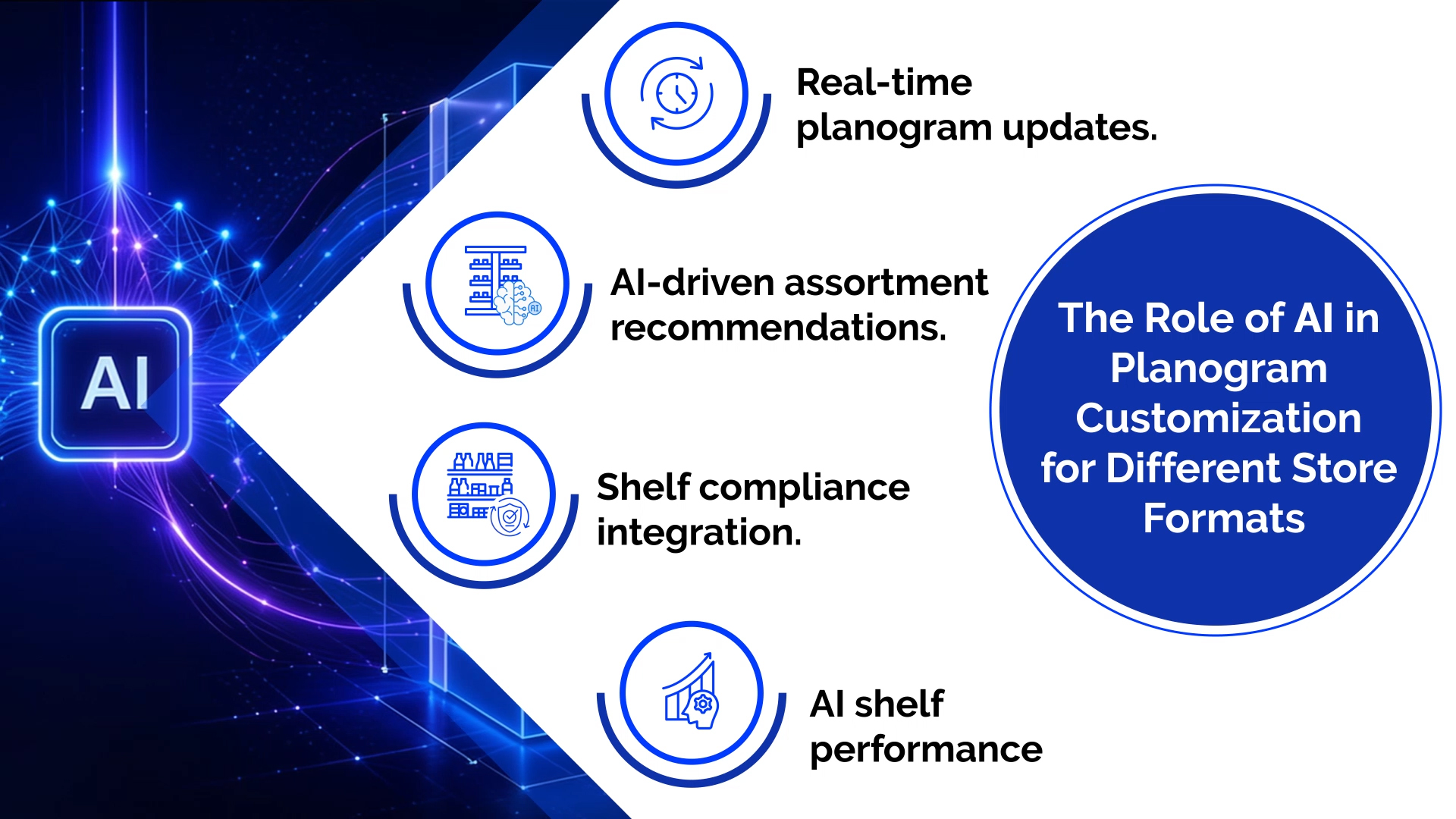
As AI technology continues to evolve, planogram customization will become even more precise and automated. Future advancements may include:
- Predictive shelf planning based on future demand forecasts.
- Real-time planogram updates.
- AI-driven assortment recommendations.
- Integration with shelf compliance monitoring tools.
- Advanced computer vision for shelf performance analysis.
These innovations will enable retailers to create increasingly personalized and profitable shopping environments.
Overview of Nexgen Planogram Services
Nexgen offers store-specific planogram services for clients that optimize sales and achieve category objectives. We create customized planograms for your business to ensure that these are better aligned with your goals and merchandising strategies. Our expertise in planogram automation helps us build planograms faster, better and consistently. Whether it is creating a planogram from scratch, or a typical reset, we have the knowledge, tools, and experience to get the job done for you.
Get in Touch!
FAQ
1. What is an AI-powered planogram?
An AI-powered planogram uses artificial intelligence and retail data to create optimized shelf layouts that improve product visibility, space utilization, and sales performance.
2. How does AI customize planograms for different store formats?
AI analyzes store-specific factors such as sales data, customer preferences, store size, and inventory levels to create layouts tailored to each store's format.
3. What are the benefits of AI-driven planograms?
AI-driven planograms help increase sales, improve shelf space utilization, reduce out-of-stocks, enhance shopper experiences, and streamline merchandising operations.
4. Can AI automatically update planograms?
Yes. AI can continuously analyze real-time data and recommend planogram updates based on changing demand, seasonal trends, and inventory fluctuations.
5. Which store formats can benefit from AI-powered planograms?
AI-powered planograms can be used across supermarkets, hypermarkets, convenience stores, specialty stores, pharmacies, department stores, and dark stores.