Retailers today face increasing pressure to maximize category performance while meeting changing customer expectations. With rising competition, limited shelf space, and growing product assortments, traditional category management methods are no longer sufficient. Artificial Intelligence (AI) is transforming how retailers analyze data, allocate shelf space, optimize assortments, and improve profitability across categories.
By leveraging AI-powered insights, retailers can make faster, more accurate merchandising decisions that drive sales, reduce waste, and improve customer satisfaction. This blog explores how AI-based planogram improves category profitability in modern retail and why it has become an essential tool for category managers.
What is Category Profitability?
Category profitability refers to the ability of a product category to generate revenue and profit while efficiently utilizing retail space and resources. Factors that influence category profitability include:
- Product assortment.
- Shelf space allocation.
- Inventory management.
- Pricing strategies.
- Promotional effectiveness.
- Consumer demand patterns.
Retailers must continuously balance these factors to ensure every category contributes positively to overall store performance.
Challenges of Traditional Category Management
Many retailers still rely on historical sales reports and manual analysis when making category decisions. This approach often leads to:
- Overstocking slow-moving products.
- Understocking high-demand items.
- Inefficient shelf space utilization.
- Poor assortment planning.
- Delayed response to market trends.
- Reduced profitability.
As product assortments expand and consumer behavior becomes more dynamic, manual category management planogram software becomes increasingly difficult.
How AI Improves Category Profitability?
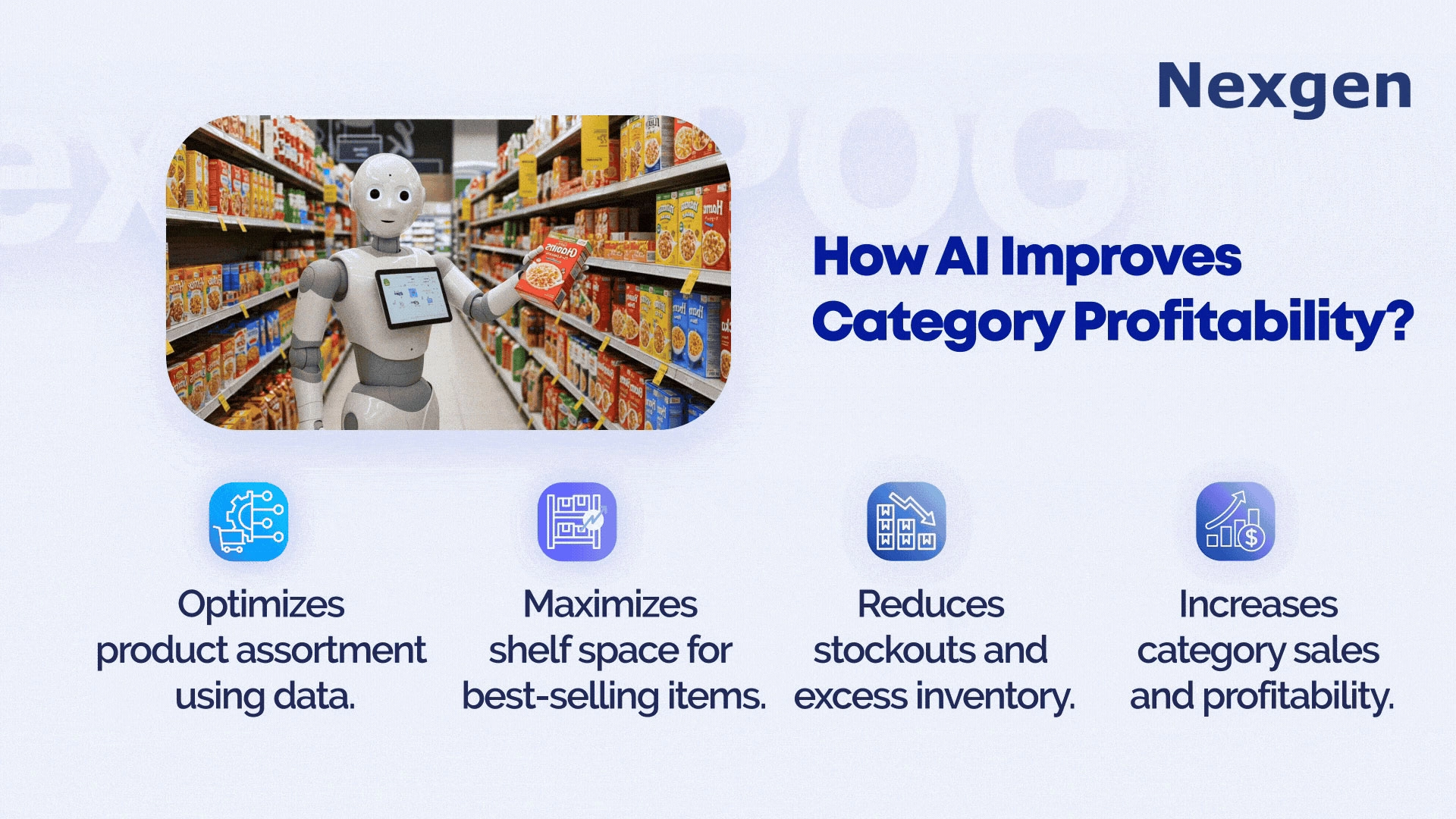
1. Data-Driven Assortment Optimization
AI analyzes large volumes of sales, inventory, customer, and market data to identify which products contribute most to category performance. Benefits include:
- Identifying top-performing SKUs.
- Eliminating low-performing products.
- Reducing assortment complexity.
- Improving inventory efficiency.
- Increasing category sales.
Retailers can ensure that shelf space is dedicated to products that generate the highest return.
2. Smarter Shelf Space Allocation
Shelf space directly impacts product visibility and sales performance. AI helps retailers determine the optimal amount of space each category and product should receive. AI can:
- Analyze sales per square foot.
- Evaluate shelf productivity.
- Recommend shelf adjustments.
- Optimize category layouts.
This ensures high-performing products receive adequate visibility while reducing space wasted on low-performing items.
3. Better Demand Forecasting
Accurate forecasting is essential for maintaining profitable categories. AI uses historical sales, seasonal patterns, local demand trends, and external factors to predict future demand. Advantages include:
- Reduced stockouts.
- Lower excess inventory.
- Improved replenishment planning.
- Better inventory turnover.
Retailers can align inventory levels with actual customer demand, improving both sales and profitability.
4. Enhanced Product Placement Decisions
AI identifies the most effective placement for products within a category by analyzing shopper behavior and purchasing patterns. AI-driven placement strategies can:
- Increase product visibility.
- Improve cross-selling opportunities.
- Encourage impulse purchases.
- Enhance shopper navigation.
Strategic product placement helps retailers generate more revenue from existing shelf space.
5. Localized Category Planning
Consumer preferences often vary across regions, store formats, and demographics. AI helps retailers customize category assortments for individual locations. Benefits include:
- Store-specific assortments.
- Improved customer relevance.
- Increased local demand fulfillment.
- Higher category performance.
Localized planning enables retailers to maximize profitability across multiple stores without using a one-size-fits-all approach.
The Role of AI-Powered Planograms
AI-powered planograms combine category management data with merchandising execution to maximize shelf performance. Modern planogram solutions help retailers:
- Optimize shelf layouts automatically.
- Allocate space based on product performance.
- Improve planogram compliance.
- Reduce manual planning efforts.
- Standardize merchandising across multiple locations.
By integrating AI with planogramming, retailers can create more effective shelf strategies that support category growth and profitability.
Overview of Nexgen POG
Nexgen POG is a robust and user-friendly cloud-based visual merchandising tool. It is designed for quick and efficient planogramming with minimal effort. Planograms in retail can be designed by easily dragging and dropping products. AI-driven autofill capabilities can automatically arrange products based on predefined rules, category roles, and sales data, significantly reducing the time required to build accurate and high-performing planograms.
The multi-device compatibility feature of POG allows users to obtain, share, and edit planograms on any device, including mobile phones. It helps in designing store-specific planograms for increased product visibility and sales.
Get Your Free Trial Today!
FAQ
1. What is AI-driven category management in retail?
AI-driven category management uses artificial intelligence to analyze sales, inventory, customer behavior, and market trends to optimize assortments, pricing, and shelf space allocation.
2. How does AI help retailers optimize product assortments?
AI identifies high-performing and low-performing SKUs by analyzing historical and real-time data, helping retailers create more profitable product assortments.
3. Can AI improve shelf space utilization?
Yes. AI evaluates factors such as sales per square foot, product velocity, and category performance to recommend optimal shelf space allocation.
4. How do AI-powered planograms contribute to category profitability?
AI-powered planograms automatically generate shelf layouts based on sales data, category objectives, and shopper behavior, improving product visibility and sales performance.
5. How does Nexgen POG support AI-driven category management?
Nexgen POG provides AI-powered planogram creation, category management tools, Autofill functionality, Block Templates, and Floor Plan capabilities that help retailers improve category profitability.