Designing the perfect planogram is only half the battle. The real challenge begins when that planogram reaches the store floor. Products get misplaced, shelves change, stock runs out, and store teams face constant pressure to execute layouts accurately—often with limited time and resources. This gap between planogram design and in-store execution is where many retailers lose sales opportunities.
Artificial Intelligence (AI) is transforming how retailers bridge this gap. By enabling automated compliance checks and real-time shelf analysis, AI ensures that planograms are not just created—but executed exactly as intended at the shelf level.
The Compliance Challenge: Why Is Design Alone Not Enough?
Traditional planogram compliance relies heavily on manual audits, store visits, and spreadsheets. These methods are time-consuming, prone to human error, and difficult to scale across multiple locations. As a result, retailers often discover compliance issues too late, after sales have already been impacted. Common shelf-level challenges include:
- Products placed in the wrong position or sequence.
- Missing SKUs and out-of-stocks.
- Incorrect facings and shelf spacing.
- Unauthorized substitutions or overstocking.
- Inconsistent execution across stores.
Even a well-designed planogram fails to deliver results if it isn’t followed accurately on the shelf.
How AI Brings Planograms to Life on Store Shelves?
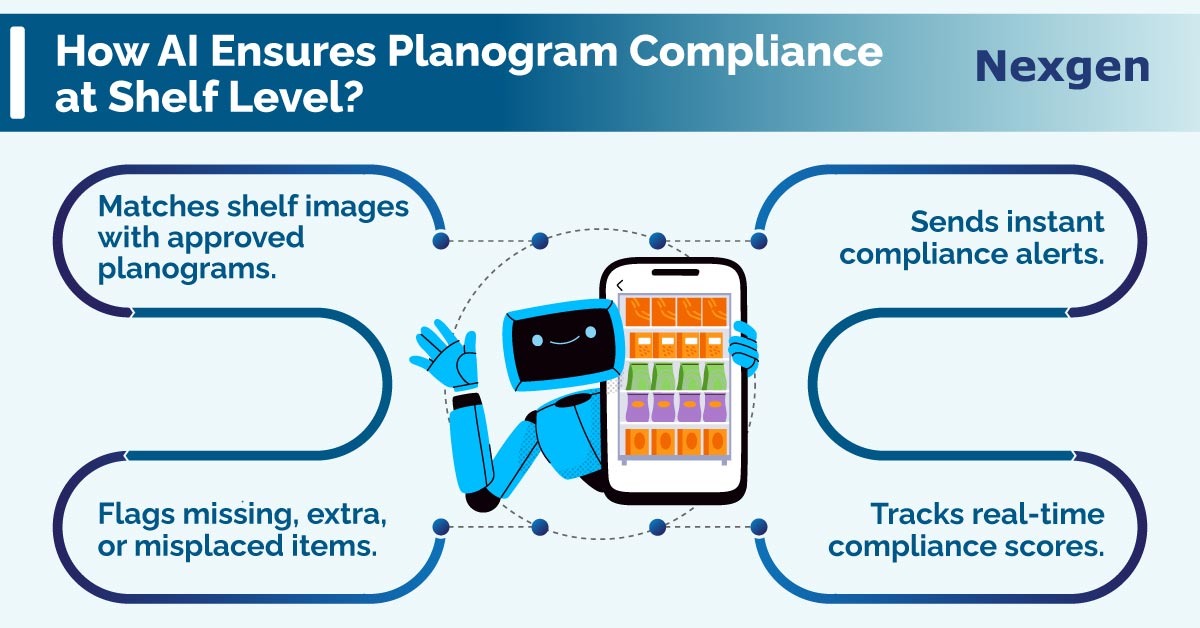
AI-powered planogram compliance tools shift retailers from reactive checks to proactive shelf intelligence. Using technologies like computer vision and machine learning, AI analyzes real shelf images and compares them against the approved planogram. Instead of just checking if the planogram was followed, AI answers:
- What exactly is non-compliant?
- Where is the issue occurring?
- How severe is the impact on sales and visibility?
This level of precision turns compliance into a measurable, actionable process.
Shelf-Level Visibility with Computer Vision
AI-powered compliance systems use shelf images captured via mobile devices or in-store cameras. Computer vision algorithms identify products, labels, facings, and shelf positions with high accuracy. These images are then matched against the planogram design to detect deviations. At the shelf level, AI can:
- Identify misplaced or incorrectly stacked products.
- Detect missing or extra facings.
- Highlight spacing and alignment issues.
- Verify brand blocking and category flow.
This eliminates guesswork and provides a clear, visual view of execution reality.
Real-Time Compliance Insights and Faster Action
One of the biggest advantages of AI-driven compliance is speed. Instead of waiting days or weeks for audit reports, retailers gain near real-time insight into shelf performance. AI-powered dashboards help:
- Flag high-priority compliance issues instantly.
- Guide store teams with visual corrections.
- Enable faster replenishment and remarks.
- Reduce repeat errors through data-backed recommendations.
This ensures problems are fixed while shoppers are still in the store—not after opportunities are lost.
Consistency Across Stores and Regions
Maintaining uniform shelves across multiple stores is a major challenge for growing retailers. AI ensures consistency by applying the same compliance standards everywhere, regardless of store size or location. With AI-based compliance analysis, retailers can:
- Benchmark compliance across regions.
- Identify stores that need additional support.
- Standardize execution for promotions and seasonal layouts.
- Ensure brand and supplier agreements are followed accurately.
This level of consistency strengthens brand trust and improves shopper experience.
Turning Compliance Data into Strategic Insights
AI doesn’t just detect issues—it learns from them. Over time, compliance data reveals patterns that help retailers refine both planogram design and execution strategies. Retailers can use AI insights to:
- Improve future planogram designs based on real-world execution.
- Identify categories with recurring compliance challenges.
- Optimize shelf space for better availability and visibility.
- Align merchandising decisions with actual store behavior.
Compliance becomes a feedback loop that continuously improves performance.
The Business Impact of AI-Driven Planogram Compliance
When planograms are executed correctly at the shelf level, the benefits are immediate and measurable:
- Higher on-shelf availability.
- Improved shopper navigation and engagement.
- Increased sales per square foot.
- Reduced operational costs from manual audits.
- Stronger collaboration between headquarters and stores.
AI ensures that every shelf reflects the strategy behind the planogram—consistently and accurately.
Overview of Nexgen POG
Nexgen POG is a robust and user-friendly cloud-based visual merchandising tool. It is designed for quick and efficient planogramming with minimal effort. Planograms in retail can be designed by easily dragging and dropping the products. The multi-device compatibility feature of POG allows you to obtain, share and edit on any device, including your phone. It helps in designing store-specific planograms for increased product visibility and sales.
Get Your Free Trial Today!