Today’s shoppers do not follow a straight path to purchase. They research products online, compare prices on their phones, purchase in-store, and typically encounter products through multiple touchpoints before making a decision. In this complex omnichannel journey, cross-merchandising has evolved from a visual tactic into a strategic growth lever—one that connects channels, increases basket size, and enhances the overall shopping experience.
The Shift from Single-Channel to Omnichannel Shopping
Modern retail is no longer divided into “online” and “offline.” Shoppers expect:
- Consistent product availability.
- Relevant recommendations.
- Seamless transitions between channels.
Cross-merchandising using a planogram helps retailers mirror digital recommendation logic in physical stores and align in-store displays with online product pairings, creating a unified experience across channels.
Cross-Merchandising Drives Higher Basket Value
When done right, cross-merchandising increases average order value without aggressive promotions. Following are the key factors in cross-merchandising:
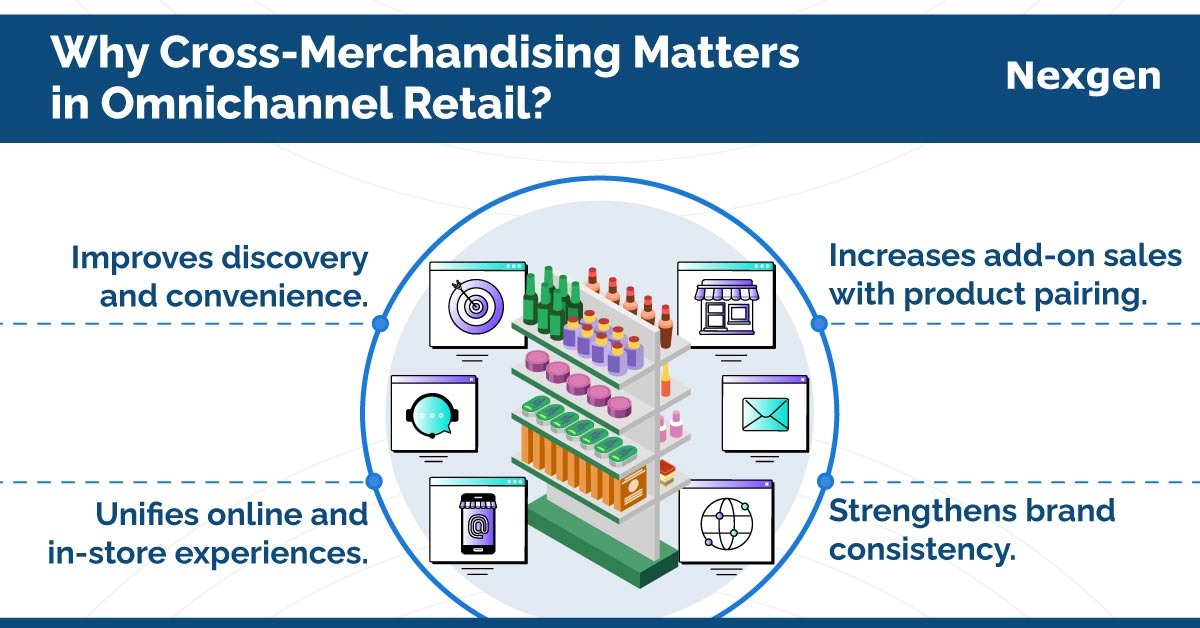
1. Omnichannel shoppers expect contextual relevance.
Digital platforms have trained shoppers to expect personalized, relevant recommendations. Cross-merchandising helps deliver that same relevance in-store by:
- Grouping products based on usage, not just category.
- Aligning shelf placement with online “frequently bought together” insights.
- Adapting layouts to local shopper behavior.
This creates a more intuitive shopping experience that feels personalized—even in physical spaces.
2. Planograms make omnichannel cross-merchandising scalable.
Executing cross-merchandising consistently across multiple stores and channels is challenging without structure. This is where planograms play a critical role. With planogram-led planning, retailers can:
- Standardize cross-merchandising strategies across stores.
- Adapt layouts for different formats and fixtures.
- Ensure alignment between digital shelf logic and physical shelves.
- Maintain execution accuracy through compliance tracking.
Planograms turn cross-merchandising from an idea into a repeatable, scalable strategy.
3. Supporting BOPIS and click-and-collect journeys.
Buy Online, Pick Up In-Store (BOPIS) has changed how shelves function. Cross-merchandising near pickup points or within fulfillment zones allows retailers to:
- Encourage impulse add-ons during pickup.
- Create quick-win cross-sell opportunities.
- Improve the in-store experience for omnichannel shoppers.
Strategically placed complementary products can turn a simple pickup into an incremental sale.
4. Data-driven cross-merchandising performs better.
In omnichannel retail, intuition alone is not enough. Successful cross-merchandising is backed by data such as:
- Purchase patterns across channels.
- Shopper flow and dwell time in-store.
- Online search and recommendation analytics.
Using these insights, retailers can refine product groupings, test placements, and continuously optimize performance across both physical and digital shelves.
Overview of Nexgen POG
Nexgen POG is a robust and user-friendly cloud-based visual merchandising tool. It is designed for quick and efficient planogramming with minimal effort. Planograms in retail can be designed by easily dragging and dropping the products. The multi-device compatibility feature of POG allows you to obtain, share and edit on any device, including your phone. It helps in designing store-specific planograms for increased product visibility and sales.
Get Your Free Trial Today!