Empty shelves are one of the biggest challenges supermarkets face today. Whether caused by poor replenishment, inaccurate demand forecasting, or inefficient shelf planning, stock gaps can lead to lost sales, dissatisfied customers, and reduced brand loyalty. Studies consistently show that shoppers often switch brands or visit another store when they cannot find the product they need.
Traditional planograms have long helped retailers organize products efficiently, but today's fast-paced retail environment requires more than static shelf layouts. This is where AI-powered planogram transforms supermarket operations. By combining artificial intelligence, real-time data, and automation, retailers can optimize shelf space, improve inventory accuracy, and significantly reduce out-of-stock situations.
This blog explores how AI planogram helps supermarkets eliminate empty shelves and create a more efficient shopping experience.
Why Are Empty Shelves a Serious Retail Problem?
Empty shelves affect more than just product availability—they impact the entire retail business.
Some of the common causes include:
- Inaccurate demand forecasting.
- Poor shelf space allocation.
- Delayed replenishment.
- Manual merchandising errors.
- Seasonal demand fluctuations.
- Inefficient store execution.
- Lack of visibility into shelf performance.
The consequences include:
- Lost sales opportunities.
- Lower customer satisfaction.
- Reduced brand loyalty.
- Increased operational costs.
- Overstocking of slow-moving products.
- Poor inventory turnover.
To solve these issues, supermarkets need smart shelf planning supported by real-time data and automation.
What Are AI Planograms?
AI planograms are intelligent shelf planning solutions that use artificial intelligence, machine learning, historical sales data, customer buying behavior, inventory information, and store performance metrics to create optimized product layouts.
Unlike traditional planograms, AI planogram solutions analyze changing retail conditions and recommend improvements. They enable supermarkets to adjust shelf layouts based on actual demand instead of relying solely on manual planning.
The result is better product placement, improved stock availability, and higher shelf productivity.
How AI Planograms Help Eliminate Empty Shelves?
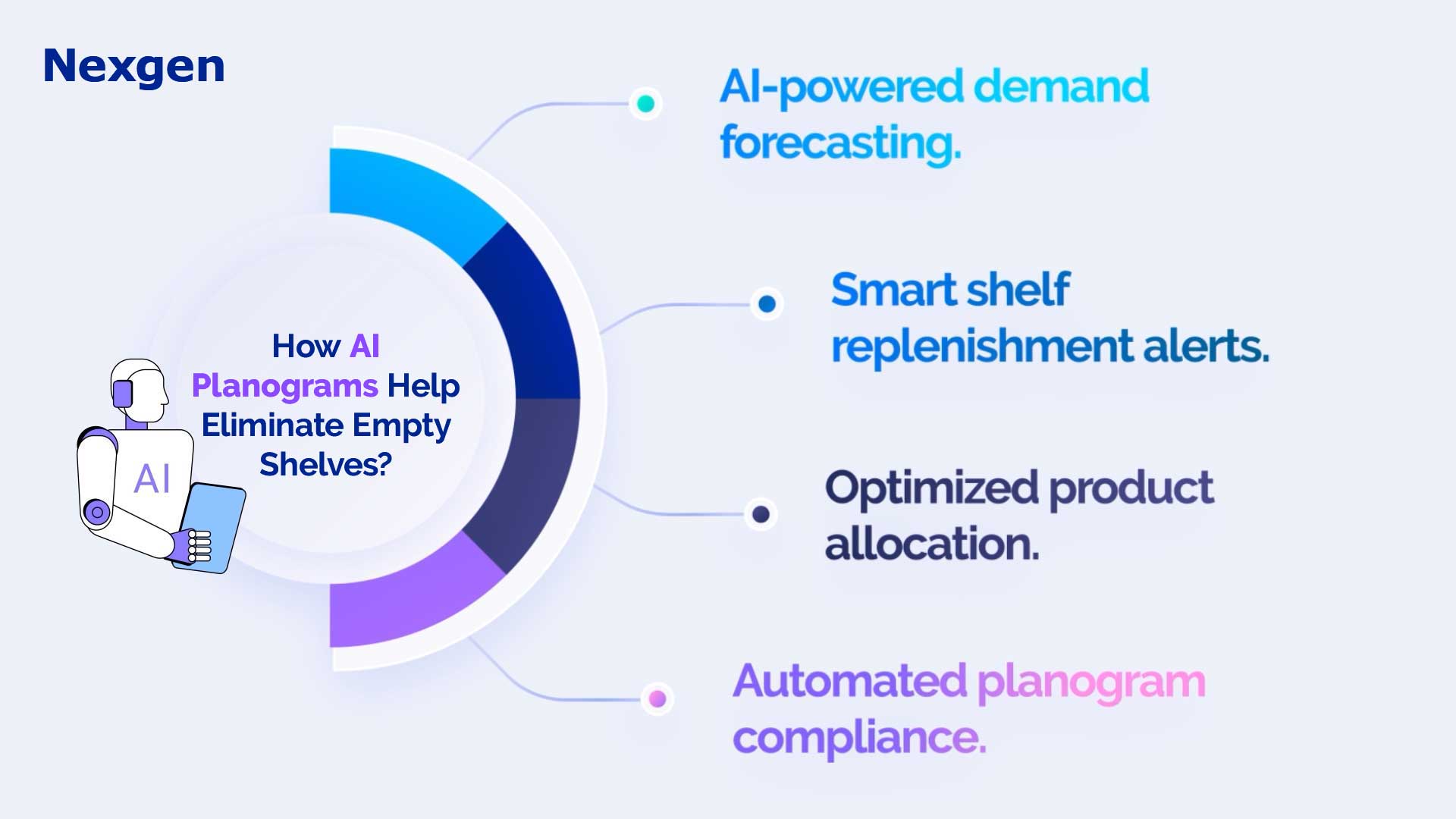
1. Predict Demand More Accurately
AI analyzes large volumes of data, including:
- Historical sales.
- Seasonal trends.
- Local buying behavior.
- Promotions.
- Weather patterns.
- Regional demand.
This allows supermarkets to anticipate product demand before stock shortages occur.
For example, if bottled water sales typically increase during summer weekends, AI recommends allocating additional shelf space before demand peaks.
2. Optimize Shelf Space Based on Product Performance
Not every product deserves the same amount of shelf space.
AI evaluates:
- Sales velocity.
- Inventory movement.
- Product profitability.
- Replenishment frequency.
- Category performance.
Fast-selling items receive additional facings, while slower-moving products occupy only the space they need. This minimizes stock-outs without increasing inventory levels.
3. Automate Planogram Creation
Creating planograms manually can take hours or even days.
AI automates the process by:
- Generating optimized layouts.
- Recommending product positioning.
- Balancing categories.
- Improving space utilization.
- Reducing planning errors.
Retail teams can quickly deploy updated planograms across multiple stores while maintaining consistency.
4. Improve Shelf Replenishment
AI does not just plan shelves—it supports smarter replenishment.
By monitoring inventory levels and product movement, AI identifies shelves likely to become empty and helps prioritize replenishment.
Benefits include:
- Faster restocking.
- Reduced shelf gaps.
- Better inventory accuracy.
- Improved labor productivity.
5. Support Store-Level Customization
Every supermarket serves different customers.
A suburban supermarket may sell more family-sized grocery packs, while an urban convenience store may require more ready-to-eat meals.
AI creates store-specific planograms based on:
- Local demographics.
- Purchase history.
- Store size.
- Regional preferences.
- Product assortment.
This ensures each store stocks the right products in the right quantities.
Benefits of AI Planograms for Supermarkets
Supermarkets implementing AI-powered planograms can achieve several measurable advantages:
- Fewer empty shelves.
- Higher product availability.
- Better shelf productivity.
- Faster replenishment cycles.
- Improved inventory management.
- Greater planogram compliance.
- Increased customer satisfaction.
- Higher sales and profitability.
- Reduced labor costs.
- Smarter merchandising decisions.
Overview of Nexgen POG
Nexgen POG is a robust and user-friendly cloud-based visual merchandising tool. It is designed for quick and efficient planogramming with minimal effort. Planograms in retail can be designed by easily dragging and dropping products. AI-driven Autofill capabilities can automatically arrange products based on predefined rules, category roles, and sales data, significantly reducing the time required to build accurate and high-performing planograms.
The multi-device compatibility feature of POG allows users to obtain, share, and edit planograms on any device, including mobile phones. It helps in designing store-specific planograms for increased product visibility and sales.
Get Your Free Trial Today!
FAQ
1. What is an AI planogram?
An AI planogram is an intelligent shelf planning solution that uses artificial intelligence, sales data, inventory information, and customer insights to automatically optimize product placement and shelf space.
2. How do AI planograms reduce empty shelves?
AI predicts demand, optimizes product facings, improves replenishment planning, and continuously updates shelf layouts to minimize stock-outs and maintain product availability.
3. Can AI planograms be customized for different supermarket locations?
Yes. AI creates store-specific planograms based on local customer preferences, store size, demographics, sales history, and regional demand patterns.
4. Do AI planograms improve inventory management?
Absolutely. AI helps retailers balance inventory levels, reduce overstocking and understocking, improve replenishment accuracy, and increase overall inventory efficiency.
5. What are the biggest benefits of AI planograms for supermarkets?
The main benefits include reduced stock-outs, better shelf utilization, faster planogram creation, improved compliance, increased operational efficiency, higher customer satisfaction, and stronger sales performance.