Retail leaders today face increasing pressure to improve profitability while adapting to changing shopper behavior, rising operational costs, and more complex product assortments. Traditional shelf planning such as planogram methods often rely on manual processes that take days or even weeks to complete, making it difficult to respond quickly to market changes.
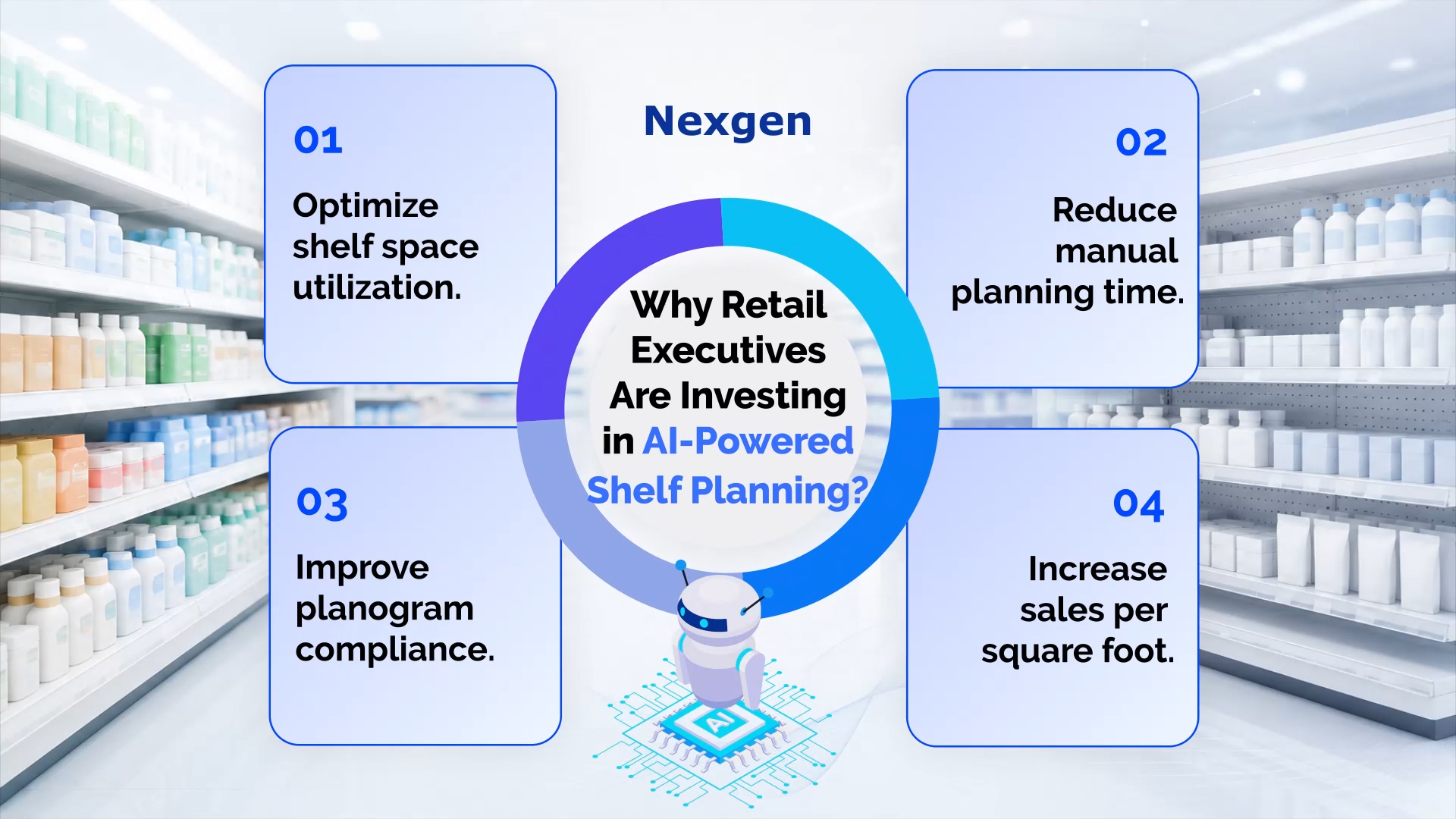
This is why more retail executives are investing in AI planogram solutions. Instead of simply digitizing shelf layouts, AI helps merchandising teams make faster, data-driven decisions that improve sales, optimize shelf space, and increase operational efficiency.
What Is an AI-Powered Planogram?
An AI-powered planogram uses artificial intelligence to analyze sales data, shopper behavior, inventory levels, and product performance to recommend optimal product placement. Unlike traditional planograms, AI continuously improves shelf layouts based on changing retail conditions.
Rather than replacing merchandising teams, AI helps them spend less time on manual planning and more time on category strategy.
Why Traditional Shelf Planning Is No Longer Enough?
Many retailers still create planograms manually using spreadsheets or outdated tools. While this approach worked in the past, today's retail environment demands greater speed and accuracy. Common challenges include:
- Long planogram creation times.
- Inconsistent execution across stores.
- Poor planogram compliance.
- Underutilized shelf space.
- Frequent out-of-stock products.
- Slow seasonal merchandising rollouts.
These issues directly affect sales, customer satisfaction, and operational costs.
1. Faster Planogram Creation
One of the biggest reasons executives invest in planogram software is to reduce the time required to create and update shelf layouts. AI can automate repetitive tasks such as:
- Product placement recommendations.
- Shelf balancing.
- Category organization.
- Space allocation.
- Product assortment optimization.
Instead of spending days building layouts manually, merchandising teams can create optimized AI planograms much faster.
Business impact:
- Reduced planning time.
- Faster merchandising decisions.
- Higher team productivity.
2. Better Shelf Space Utilization
Shelf space is one of the most valuable assets in retail. Every inch should contribute to revenue.
AI analyzes historical sales, product velocity, profitability, and demand trends to recommend the most effective shelf space planning strategy. Benefits include:
- Better allocation of high-performing products.
- Reduced wasted shelf space.
- Improved category profitability.
- Higher sales per square foot.
Instead of relying on assumptions, retailers make decisions backed by data.
3. Improved Planogram Compliance
Creating a shelf layout is only the first step. Stores must execute it correctly. Modern planogram software helps retailers monitor compliance across hundreds or thousands of locations. When paired with AI and image recognition, retailers can quickly identify:
- Missing products.
- Incorrect product placement.
- Empty shelves.
- Pricing errors.
- Shelf execution issues.
Higher compliance means customers consistently find products where they expect them.
4. Reducing Out-of-Stocks
Out-of-stock products lead to lost sales and disappointed shoppers. AI-powered planogramming helps reduce stockouts by aligning shelf allocation with product demand and improving replenishment planning. Retailers benefit from:
- Better product availability.
- Fewer empty shelves.
- Higher customer satisfaction.
- Reduced lost revenue.
5. Smarter Category Management
Not every product deserves the same amount of shelf space. AI identifies:
- High-performing products.
- Slow-moving inventory.
- Category trends.
- Seasonal demand.
- Cross-selling opportunities.
This allows category managers to continuously optimize shelf layouts based on real business performance rather than intuition.
6. Faster Seasonal Merchandising
Seasonal campaigns often require thousands of stores to update shelves within tight deadlines. Traditional planning slows execution. AI-powered planograms make it easier to:
- Update layouts quickly.
- Deploy changes across multiple stores.
- Standardize merchandising.
- Reduce rollout delays.
Retailers can respond faster to promotions, holidays, and regional demand.
7. Better Collaboration Across Teams
Large retailers involve multiple teams in shelf planning, including merchandising, category management, marketing, and store operations. Cloud-based shelf planning software enables everyone to work from the latest approved visual merchandising planogram. Benefits include:
- Real-time collaboration.
- Faster approvals.
- Reduced version conflicts.
- Improved communication.
- Consistent execution.
8. Data-Driven Executive Decisions
Retail executives want measurable business outcomes—not just new technology. AI-powered shelf planning provides insights into key performance indicators such as:
- Time to create a planogram.
- Time to deploy merchandising changes.
- Planogram compliance rates.
- Sales per square foot.
- Category profitability.
- Shelf productivity.
- Product availability.
These metrics help leaders evaluate merchandising performance and identify improvement opportunities.
AI Shelf Planning Delivers Measurable ROI
The value of AI goes beyond automation. It helps retailers achieve measurable improvements across merchandising operations. Organizations adopting AI-powered planogram solutions often aim to achieve:
- Faster planogram creation and updates.
- Better shelf space utilization.
- Improved planogram compliance.
- Reduced out-of-stock incidents.
- Higher merchandising productivity.
- More consistent execution across stores.
- Better category performance.
- Increased sales opportunities.
The result is a more agile merchandising process that supports faster decision-making and stronger business outcomes.
Why Retailers Choose Nexgen POG?
Nexgen POG combines intelligent planogram services, AI-assisted planning, and cloud-based collaboration to help retailers optimize every inch of shelf space. With Nexgen POG, retailers can:
- Create AI planograms faster.
- Improve planogram compliance.
- Optimize shelf space planning.
- Simplify visual merchandising planogram creation.
- Collaborate across merchandising teams.
- Accelerate planogram deployment.
- Improve overall category performance.
Instead of focusing solely on software features, Nexgen POG helps retailers achieve measurable business value through faster planning, better execution, and improved shelf productivity.
Conclusion
Retail executives are investing in AI-powered planogram solutions because they address real business challenges—not just merchandising tasks. By improving planogramming, optimizing shelf space, reducing stockouts, and accelerating planogram deployment, AI enables retailers to increase efficiency and make better use of every shelf.
As competition intensifies, investing in modern planogram software and intelligent planogram services is becoming a strategic advantage. Retailers that embrace AI-driven shelf planning software will be better equipped to improve category performance, enhance customer experiences, and drive long-term profitability.
Get Your Free Trial Today!
FAQ
1. What is an AI-powered planogram?
An AI-powered planogram uses artificial intelligence to recommend optimal product placement based on sales data, inventory, shopper behavior, and category performance, helping retailers improve shelf productivity and merchandising decisions.
2. How does AI improve planogram creation?
AI automates repetitive planning tasks, recommends product placements, optimizes shelf space, and accelerates updates, allowing merchandising teams to create planograms more efficiently.
3. Why is shelf space planning important in retail?
Effective shelf space planning ensures that high-performing products receive optimal placement, improving product visibility, reducing wasted space, and increasing sales per square foot.
4. What are the benefits of planogram software?
Modern planogram software helps retailers create accurate shelf layouts, improve compliance, optimize merchandising, reduce stockouts, support collaboration, and make data-driven decisions.
5. How do AI planograms improve retail performance?
AI planograms continuously analyze retail data to optimize shelf layouts, improve category profitability, enhance compliance, reduce out-of-stock products, and support faster merchandising execution.