Seasonal retail is a race against time. From holiday promotions and back-to-school campaigns to summer collections and festive assortments, retailers have a limited window to capture shopper demand. Yet, traditional planogram development and deployment can take weeks, creating delays between planning and execution.
Faster planogram deployment helps retailers move from weeks to days, allowing seasonal shelf changes to reach stores while the opportunity is still relevant.
With modern planogram software, AI-driven workflows, and streamlined collaboration, retailers can accelerate planogramming, optimize shelf space planning, and improve execution across stores. The result is not simply faster AI planogram creation — it is better seasonal readiness, quicker response to market changes, and more consistent visual merchandising planogram execution.
Why Do Seasonal Planograms Take So Long to Deploy?
Traditional planogram workflows often involve multiple manual steps and teams. A typical process may look like:
Assortment selection → Shelf space planning → Planogram creation → Review → Approval → Store communication → Implementation
When these activities depend heavily on spreadsheets, disconnected systems, manual product placement, and repeated approvals, even small changes can create significant delays. Common causes of slow planogram deployment include:
- Manual Planogram Creation: Building seasonal planograms manually can require significant time, especially when retailers manage thousands of products and multiple store formats.
- Repetitive Product Placement: Category managers and space planners may spend hours positioning products, checking shelf capacity, and making adjustments.
- Multiple Review Cycles: Seasonal layouts often require input from merchandising, category management, operations, and other stakeholders. Repeated revisions can extend deployment timelines.
- Disconnected Data: When product, store, assortment, and planogram information exists across different systems, teams may spend additional time collecting and validating information.
- Store-Level Variations: A single seasonal strategy may need to be adapted for different store sizes, clusters, fixtures, and regional assortments.
These challenges make speed difficult—but modern planogram software can significantly streamline the process.
How Faster Planogram Deployment Improves Seasonal Readiness?
Reducing planogram deployment from weeks to days creates more time for retailers to focus on execution and optimization.
1. Seasonal Products Reach Shelves Faster
The first advantage is straightforward: faster deployment means seasonal products can reach stores sooner. Instead of spending most of the seasonal preparation period developing layouts, retailers can move quickly from planning to implementation. This is especially important for short-duration events where missing even a few days of demand can affect sales performance.
2. Retailers Can Respond Faster to Demand Changes
Seasonal demand is not always predictable. A product may sell faster than expected; a promotion may change, or a new product may suddenly become a priority. With faster planogramming, retailers can modify shelf layouts and distribute updated plans more quickly. This creates a more responsive planning cycle:
Detect change → Update planogram → Approve → Deploy → Implement
The shorter this cycle becomes, the easier it is to respond to changing shopper behavior.
3. More Time for Store Execution
A planogram is only valuable when it is implemented correctly. When retailers spend less time creating and approving layouts, stores have more time to execute them. This can help teams:
- Prepare fixtures.
- Move existing products.
- Add seasonal displays.
- Verify product placement.
- Correct implementation issues.
- Prepare for peak shopping periods.
Faster planning therefore creates additional execution time without necessarily increasing the length of the seasonal window.
How Do AI-Powered Planograms Accelerate Seasonal Planning?
AI powered planogram technology can further reduce the time required to create and modify shelf layouts. Traditional planogramming often requires planners to manually determine where products should be positioned. AI can assist by using predefined rules, product attributes, assortment information, historical data, and space constraints to recommend or automate placements. AI planograms can help retailers:
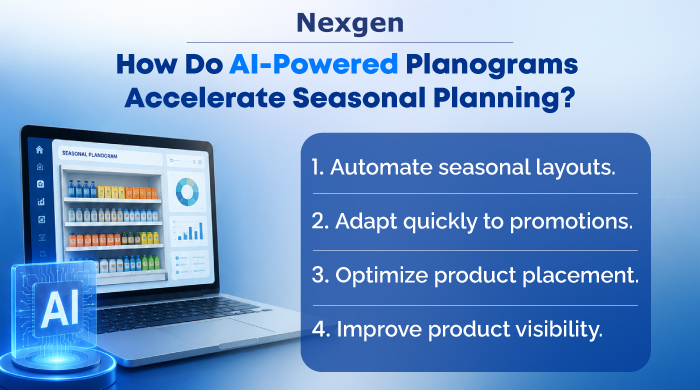
- Automate product placement.
- Identify suitable shelf positions.
- Apply assortment rules.
- Optimize available shelf space.
- Create layouts faster.
- Make bulk changes across multiple planograms.
- Reduce repetitive manual work.
Instead of replacing the planner, AI can reduce time spent on repetitive activities so teams can focus on category strategy and decision-making.
From Weeks to Days: Where the Time Savings Come From
The biggest opportunity for retailers is not necessarily eliminating one step. It is reducing friction across the entire workflow. Consider a traditional process:
Manual creation → Multiple revisions → Manual validation → Approval → Store communication → Implementation
A technology-enabled workflow can simplify this into:
Automated creation → Collaborative review → Faster approval → Digital deployment → Store execution
AI-powered capabilities can further reduce repetitive tasks. For example, reusable templates and automated assortment placement can help planners start with an optimized structure instead of building every seasonal plan from scratch. The cumulative effect can be significant. If planners save time at several stages of the workflow, the total deployment cycle can shrink from weeks to days.
Faster Deployment Also Improves Planogram Agility
Speed should not be viewed only as a one-time benefit. The real advantage is planogram agility—the ability to continuously adjust shelf layouts when business conditions change. For example:
- Week 1: Seasonal planogram is deployed.
- Week 2: A product begins outperforming expectations.
- Week 3: The retailer increases its shelf allocation.
- Week 4: A new promotion has been introduced.
With a faster planning and deployment process, each adjustment can reach stores sooner.
This turns planogramming from a periodic activity into a more responsive retail planning process.
What Should Retailers Measure?
To understand whether faster deployment is creating business value, retailers should track more than planogram creation time. Important metrics include:
- Time to create a planogram.
- Time to approve a planogram.
- Time to deploy a planogram.
- Time from planning to store implementation.
- Planogram compliance rate.
- Sales performance after implementation.
- Shelf space utilization.
- Out-of-stock reduction.
- Time required for seasonal resets.
- Number of manual interventions.
These metrics help connect operational improvements with measurable retail outcomes.
How Nexgen POG Helps Retailers Deploy Planograms Faster?
Nexgen POG is designed to help retailers simplify and accelerate the planogram lifecycle. With capabilities such as AI-driven autofill, reusable templates, bulk updates, collaboration, planogram approval workflows, and planogram lifecycle management, retailers can reduce repetitive work and move faster from planning to deployment.
AI-assisted workflows can help planners automate product placement while maintaining control over merchandising rules and business requirements. For seasonal planning, this means teams can spend less time building layouts manually and more time focusing on assortment strategy, shelf performance, and execution. The objective is simple: help retailers move from planogram planning to store-ready execution faster.
Get Your Free Trial Today!
FAQ
1. How does faster planogram deployment improve seasonal readiness?
It helps retailers launch seasonal products and promotions faster, giving stores more time to execute shelf changes and capture demand.
2. How do AI-powered planograms speed up retail planning?
AI automates tasks like product placement and assortment filling, reducing manual work and speeding up planogram creation.
3. Why is planogram software important for seasonal planning?
It streamlines planogram creation, collaboration, approval, and deployment, helping retailers execute seasonal changes more efficiently.
4. How can retailers measure planogram deployment speed?
Key metrics include creation, approval, deployment, implementation, compliance, and sales performance.
5. Can planogram services support seasonal campaigns?
Yes. Planogram services can assist with seasonal layouts, assortment planning, shelf space planning, updates, and compliance.