A shopper enters a store with a simple goal: find the products they need quickly and complete their purchase. But when essential items are difficult to locate, shelves appear disorganized, or products are placed in unexpected locations, frustration builds. Many shoppers simply give up, leave the store, or switch to another retailer.
This is the science of findability—the ease with which customers can locate products inside a store. While retailers often focus on promotions, pricing, and assortment, one critical factor is often overlooked: how quickly shoppers can find what they came to buy. A well-designed planogram does more than organize shelves. It creates an intuitive shopping journey that improves customer satisfaction, increases operational efficiency, and drives higher sales.
Why Findability Matters More Than Ever
Modern shoppers expect convenience. Whether shopping in supermarkets, pharmacies, convenience stores, or specialty retailers, they want products to be exactly where they expect them to be.
When customers struggle to locate products, retailers face several challenges:
- Lost sales from abandoned purchases.
- Lower customer satisfaction.
- Increased reliance on store associates.
- Reduced basket size.
- Lower brand loyalty.
Poor shelf navigation is no longer just a merchandising issue. It is a business performance issue.
The Hidden Cost of Poor Shelf Navigation
Retail executives often focus on inventory availability, but product availability alone is not enough. Products must also be easy to find.
Common challenges include:
- Poor planogram compliance.
- Inconsistent execution across stores.
- Wasted shelf space.
- Slow rollout of seasonal planograms.
- Difficult product adjacencies.
- Inefficient category layouts.
Each of these issues contributes to a poor shopping experience and affects key retail metrics, including sales per square foot, category profitability, and customer retention.
How AI Is Transforming Planogramming?
Traditional planogramming often relies on manual updates, spreadsheets, and time-consuming revisions. As assortments grow and consumer preferences evolve, maintaining accurate shelf layouts becomes increasingly difficult.
AI-powered AI planogram solutions help merchandising teams analyze store data, product performance, shelf dimensions, shopper behavior, and merchandising rules to recommend optimized layouts for different store formats. This enables retailers to respond faster to changing demand while maintaining consistency across stores.
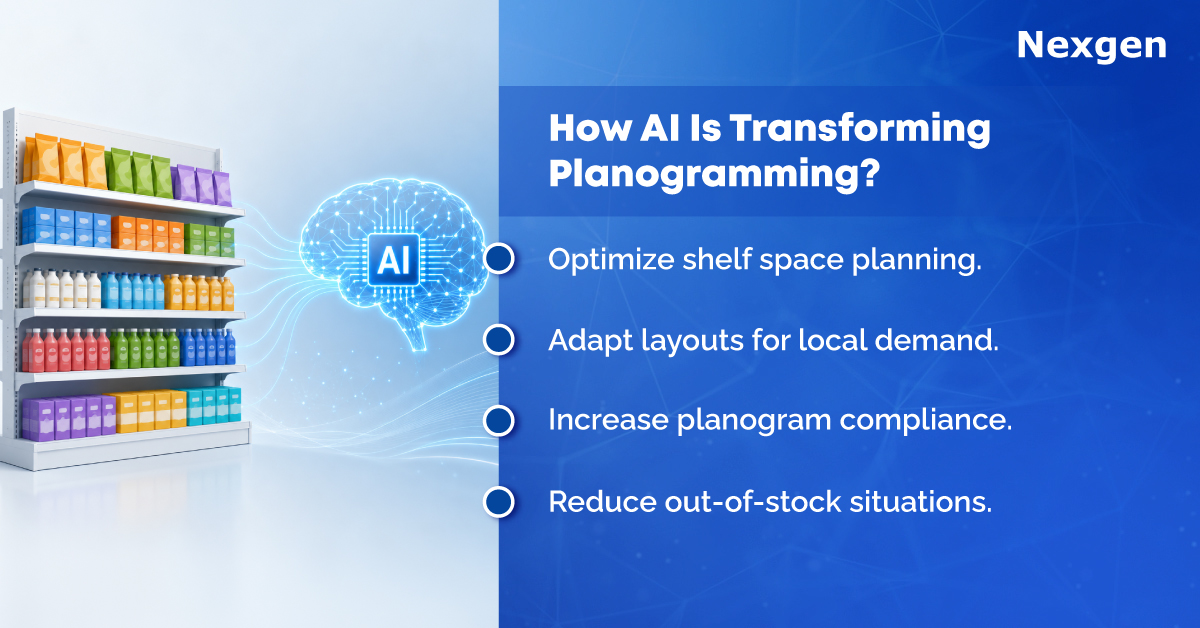
An AI-powered approach helps retailers:
- Improve product visibility.
- Optimize shelf space planning.
- Adapt layouts for local demand.
- Increase planogram compliance.
- Reduce out-of-stock situations.
- Improve shopper navigation.
The result is a store that is easier to shop, simpler to manage, and more profitable to operate.
Focus on Business Outcomes
Retail executives are interested in measurable business improvements rather than software features alone. The real question is not whether software can generate planograms, but how much value it creates for the business.
Retailers typically spend hundreds of hours creating and maintaining planograms. By automating much of this process, merchandising teams can redirect valuable time toward category strategy, assortment optimization, and faster execution.
Important business metrics include:
- Time required to create a planogram.
- Time required to deploy merchandising changes.
- Improvement in planogram compliance.
- Reduction in out-of-stock products.
- Better shelf space utilization.
- Higher sales per square foot.
- Improved category performance.
These metrics help retailers evaluate the true return on investment in modern merchandising technology.
Better Findability Creates Better Shopping Experiences
An effective visual merchandising planogram ensures products are positioned where shoppers naturally expect to find them. When shelves are logical, organized, and consistent, customers spend less time searching and more time purchasing.
AI helps merchandising teams:
- Group complementary products together.
- Prioritize high-demand products.
- Optimize eye-level product placement.
- Improve promotional visibility.
- Customize layouts for different store formats.
- Support faster merchandising decisions.
These improvements create a smoother shopping journey while increasing operational efficiency.
Solve Retail Challenges, Not Technology Problems
Successful merchandising strategies begin by solving business challenges rather than promoting software features.
Retailers continue to face issues such as:
- Out-of-stock products that reduce revenue.
- Poor planogram compliance across stores.
- Wasted shelf space.
- Slow rollout of promotional displays.
- Low category profitability.
- Inconsistent execution across multiple locations.
The objective is to improve sales per square foot while reducing the time required to create, manage, and deploy planograms across the retail network.
How Nexgen POG Supports Retailers?
Nexgen POG is designed to help retailers optimize shelf space, improve planogram compliance, and accelerate merchandising decisions through AI-assisted planning and cloud-based collaboration.
Rather than requiring lengthy enterprise implementations, the platform is designed to deliver measurable business value quickly while integrating with existing retail systems.
Retailers can improve:
- Shelf productivity.
- Better space utilization.
- Faster planogram deployment.
- Higher merchandising efficiency.
- Improved planogram compliance.
- Better category performance.
- Faster decision-making across stores.
The goal is to help merchandising teams spend less time on manual planogram creation and more time delivering better customer experiences and stronger business performance.
Final Thoughts
Findability is becoming one of the most important factors influencing the in-store shopping experience. Even when products are available, poor shelf navigation can lead to abandoned purchases, lower customer satisfaction, and lost revenue.
AI-powered planograms enable retailers to create more intuitive shelf layouts, improve operational efficiency, and deliver consistent merchandising execution across every location. As competition continues to grow, retailers that invest in intelligent shelf planning and better planogram software will be well positioned to improve shopper experiences, increase category performance, and maximize every inch of shelf space.
Overview of Nexgen POG
Nexgen POG is a robust and user-friendly cloud-based visual merchandising tool. It is designed for quick and efficient planogramming with minimal effort. Planograms in retail can be designed by easily dragging and dropping products. AI-driven Autofill capabilities can automatically arrange products based on predefined rules, category roles, and sales data, significantly reducing the time required to build accurate and high-performing planograms.
The multi-device compatibility feature of POG allows users to obtain, share, and edit planograms on any device, including mobile phones. It helps in designing store-specific planograms for increased product visibility and sales.
Get Your Free Trial Today!
FAQ
1. What is retail findability?
Retail findability refers to how easily shoppers can locate products within a store. Better findability improves customer satisfaction, reduces abandoned purchases, and increases sales.
2. How do AI-powered planograms improve findability?
AI-powered planograms analyze sales data, shopper behavior, and shelf performance to recommend optimized product placement, making products easier for customers to locate.
3. Why does poor shelf navigation affect retail sales?
Poor shelf navigation causes customer frustration, increases reliance on store associates, reduces basket size, and often leads to abandoned purchases or shoppers switching to competitors.
4. What business benefits do AI planograms provide?
AI planograms help retailers improve shelf space utilization, increase planogram compliance, reduce out-of-stock situations, accelerate merchandising decisions, and improve category performance.
5. How does Nexgen POG improve in-store findability?
Nexgen POG uses AI-assisted planogram creation, automated shelf optimization, and compliance monitoring to create intuitive shelf layouts that improve product visibility, shopper navigation, and overall retail performance.