Creating and maintaining planograms can be a time-consuming process for retail merchandising teams. From reviewing product data and arranging SKUs to making revisions and creating layouts for different stores, manual planogram creation requires significant effort.
AI-assisted planogram services help retailers automate many repetitive planning tasks, allowing merchandising teams to spend less time on manual shelf planning and more time on strategic decisions. By using product data, templates, merchandising rules, and automation, retailers can accelerate planogram creation and ongoing maintenance.
Why Does Planogram Creation Take So Much Time?
Traditional planogram creation involves several steps, including:
- Reviewing product and sales data.
- Selecting products for each category.
- Determining shelf positions and facings.
- Creating and adjusting layouts.
- Developing variations for different store formats.
- Making changes based on inventory or assortment updates.
- Checking whether the final planogram follows merchandising rules.
When these activities are performed manually, even small changes can require considerable time, especially when retailers manage thousands of products across multiple stores.
How Does AI-Assisted Planogram Creation Save Time?
AI can support merchandising teams by automating repetitive planning and analysis activities. Instead of starting every planogram from scratch, retailers can use existing data, templates, rules, and product information to accelerate the creation process.
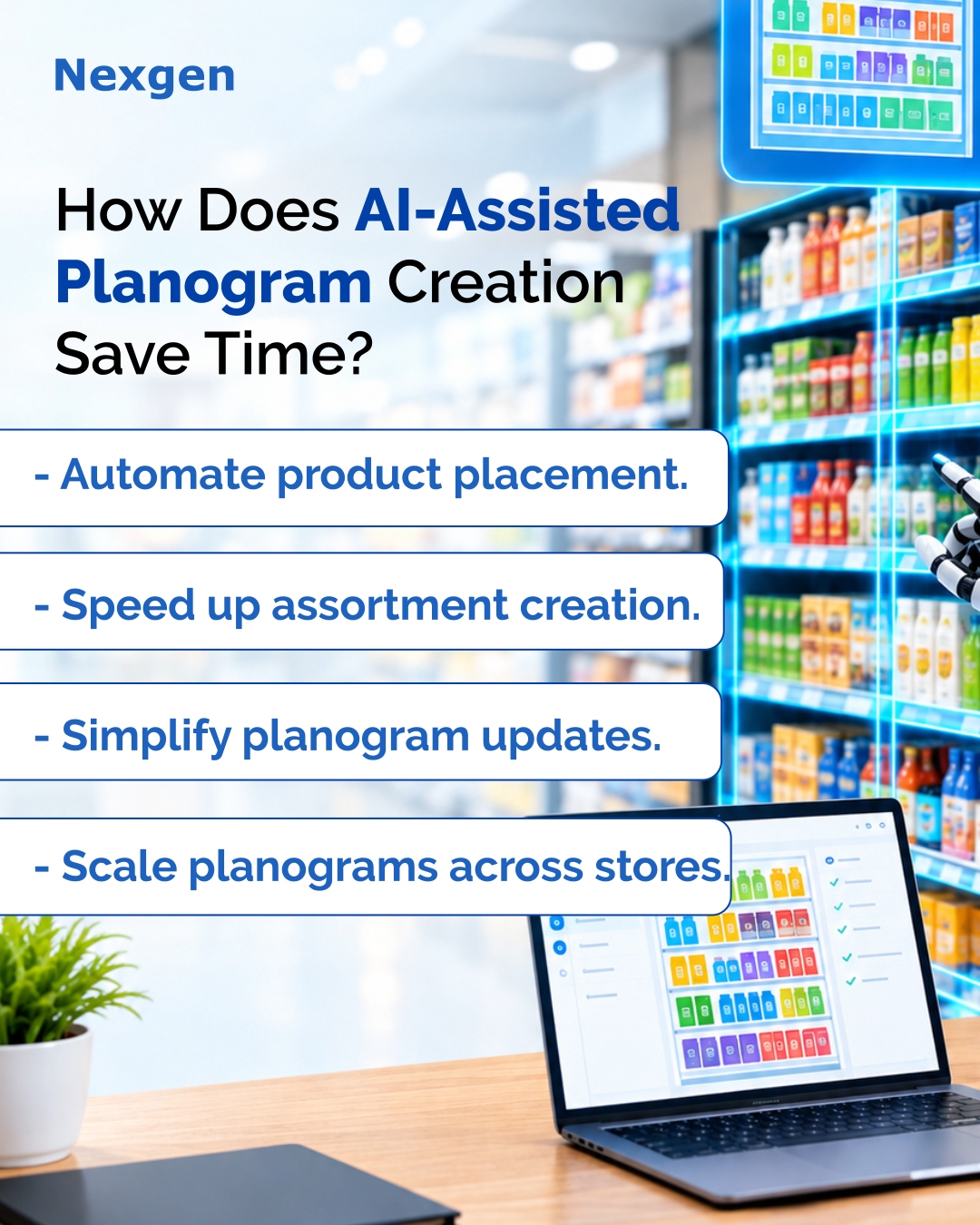
AI-assisted tools can help with:
1. Faster Product Placement
AI can analyze product attributes, sales performance, category rules, and available shelf space to recommend suitable product placements. This reduces the need for merchandisers to manually test multiple arrangements.
2. Automated Assortment Creation
Retailers can use AI-driven assortment capabilities to identify suitable products for specific shelf spaces or store formats. This can reduce the time required to build assortments manually.
3. Quicker Planogram Updates
Product introductions, discontinued SKUs, packaging changes, and assortment adjustments can require frequent planogram revisions. AI-assisted workflows can help teams make these changes faster without rebuilding layouts from the beginning.
4. Faster Creation Across Store Clusters
Retailers rarely use exactly the same planogram in every location. Store size, shopper behavior, and product availability can vary by market.
AI can help create variations based on predefined rules and store requirements, making it easier to scale planograms across multiple locations.
5. Reduced Manual Checking
AI can assist with identifying potential placement issues, compliance gaps, and shelf-space inconsistencies. This allows merchandising teams to spend less time manually reviewing every layout.
How Much Time Can Retailers Actually Save?
The exact time savings depend on factors such as the number of SKUs, store count, planogram complexity, data quality, and the level of automation being used.
For example, a merchandising team that spends several hours creating and reviewing a single planogram may be able to reduce manual effort substantially by using reusable templates, automated assortment creation, and AI-assisted placement.
The bigger opportunity comes at scale. If a retailer needs to create or update hundreds of planograms, even a small reduction in time per planogram can translate into hundreds of hours saved across the merchandising organization.
Where Do the Biggest Time Savings Come From?
AI-assisted planogramming can create time savings throughout the planogram lifecycle.
| Manual Activity |
AI-Assisted Approach |
| Product selection |
Data-driven product recommendations |
| Shelf placement |
AI-assisted placement |
| Assortment creation |
Automated assortment generation |
| Layout revisions |
Faster planogram updates |
| Store variations |
Rule-based and data-driven variations |
| Compliance review |
Automated compliance checks |
| Repetitive adjustments |
Automated workflows |
This means AI's value goes beyond creating the initial planogram. It can also help reduce the ongoing effort needed to manage and maintain planograms.
Time Saved Can Become Business Value
Saving time is important, but retailers should look beyond hours saved.
When merchandising teams spend less time performing repetitive tasks, they can redirect that time toward activities such as:
- Category strategy.
- Assortment optimization.
- Store-specific planning.
- Promotional planning.
- Performance analysis.
- Planogram compliance.
- Identifying sales opportunities.
This shift can help retailers move from manually managing planograms to continuously improving shelf performance.
How Should Retailers Measure AI Planogram ROI?
Retailers considering AI-assisted planogram creation should track measurable outcomes before and after implementation.
Important metrics include:
- Average time to create a planogram.
- Average time to update an existing planogram.
- Number of planograms created per employee.
- Time required to roll out changes across stores.
- Planogram compliance rates.
- Shelf-space utilization.
- Out-of-stock rates.
- Sales performance by category.
- Merchandising hours saved.
Instead of simply saying that AI makes planogram creation faster, retailers can measure how many hours their merchandising team previously spent creating and maintaining planograms and compare that figure with the time required after automation.
AI Does Not Replace Merchandising Expertise
AI-assisted planogramming is not about removing merchandisers from the process. Instead, it helps reduce repetitive work so teams can focus on decisions that require business knowledge and strategic judgment.
Merchandisers still need to define category objectives, understand shopper behavior, establish business rules, and evaluate the recommendations produced by the system.
The goal is to combine human expertise with automation to create a faster and more scalable planning process.
Overview of Nexgen Planogram Services
Nexgen offers store-specific planograms that help retailers optimize shelf layouts, improve merchandising efficiency, and achieve category objectives. Our expertise in planogram automation helps retailers create and update planograms faster while maintaining consistency across stores. Whether creating a planogram from scratch or managing a typical reset, Nexgen provides the knowledge, tools, and experience needed to support efficient planogram execution.
Get in Touch!
FAQs
1. How much time can retailers save with AI-assisted planogram creation?
The amount of time saved depends on planogram complexity, SKU count, store count, and automation level, but AI can significantly reduce repetitive manual planning and update tasks.
2. How does AI make planogram creation faster?
AI can assist with product placement, assortment creation, shelf-space allocation, layout updates, and compliance checks, reducing the amount of manual work required.
3. Can AI create planograms for different store formats?
Yes. AI-assisted planogram tools can use store-specific rules, available space, assortments, and product data to help create layouts suited to different store formats.
4. Does AI-assisted planogramming replace merchandisers?
No. AI supports merchandisers by handling repetitive tasks while allowing them to focus on category strategy, shopper needs, and business decisions.
5. How can retailers measure the ROI of AI-assisted planogramming?
Retailers can track metrics such as planogram creation time, update time, merchandising hours saved, compliance rates, shelf-space utilization, and sales performance.