In today’s fast-paced retail environment, maintaining well-stocked and accurately organized shelves is critical for maximizing sales and delivering a seamless shopping experience. AI-powered image recognition is transforming planogram execution, shelf monitoring, and retail compliance by enabling real-time detection of out-of-stock (OOS) and misplaced products across stores.
This is where planogram services play a crucial role. By integrating AI with planogram strategies, retailers can ensure accurate shelf execution, improve compliance, and create more efficient in-store experiences.
What is AI-Powered Image Recognition in Retail?
AI-powered image recognition in retail uses computer vision and machine learning algorithms to analyze shelf images captured through cameras, mobile devices, or in-store systems. It helps retailers:
- Identify products on shelves in real time.
- Compare actual shelf layouts with planograms.
- Detect compliance issues automatically.
- Improve retail execution accuracy.
When integrated with planogram software, it automates shelf audits and ensures consistent visual merchandising across locations.
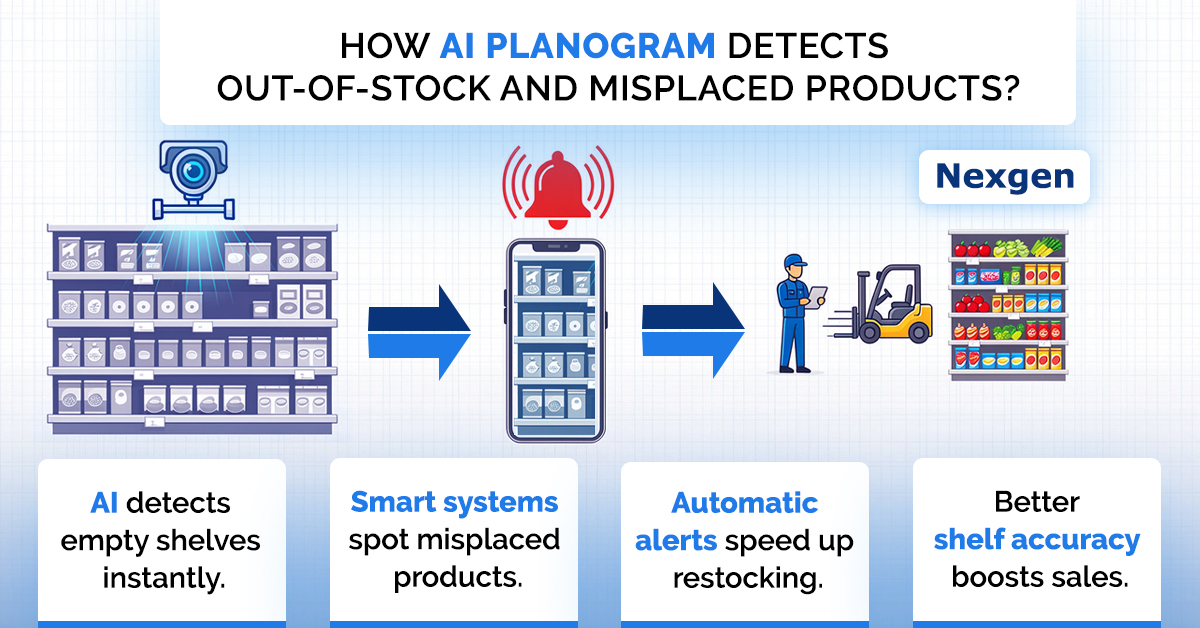
How Does AI Detect Out-of-Stock Products?
AI detects out-of-stock products by continuously analyzing shelf images and identifying gaps or missing items.
- Real-time shelf scanning to detect empty or low-stock spaces.
- SKU-level comparison with planogram data.
- Instant alerts for replenishment actions.
- Historical tracking of OOS patterns for better demand forecasting.
AI-powered image recognition detects out-of-stock products by scanning shelves in real time, identifying empty spaces, comparing them with planograms, and triggering alerts for restocking.
How Does AI Identify Misplaced Products?
AI systems use visual recognition to detect incorrect product placements that violate planogram guidelines.
- Recognizes products using packaging, size, and label data.
- Maps product positions against predefined planograms.
- Flags items placed in incorrect shelf locations.
- Provides corrective recommendations for store teams.
AI identifies misplaced products by recognizing items on shelves and comparing their positions with planogram layouts to detect incorrect placements.
How AI Improves Planogram Compliance?
AI-powered image recognition ensures that stores follow visual merchandising planograms accurately.
- Reduces manual audits and human errors.
- Enables real-time compliance monitoring.
- Standardizes execution across multiple stores.
- Improves visibility into shelf performance.
This helps retailers bridge the gap between planogram design and in-store execution.
Key Benefits of AI-Powered Shelf Monitoring
- Reduce lost sales caused by out-of-stock products.
- Improve operational efficiency through automation.
- Enhance customer experience with well-organized shelves.
- Enable data-driven decision-making.
- Scale across large retail chains and multi-store environments.
Continuous Improvement with Real-Time Retail Insights
AI systems continuously learn from shelf data, improving detection accuracy and performance over time.
- Analyze real store conditions vs. planned layouts.
- Identify recurring shelf execution issues.
- Optimize shelf space planning and product placement.
- Refine planograms based on real-time insights.
This creates a closed-loop retail optimization system that drives continuous improvement.
Conclusion
AI-powered image recognition is revolutionizing retail by enabling automated detection of out-of-stock and misplaced products. By combining planogram software, real-time shelf analytics, and AI-driven insights, retailers can improve compliance, enhance operational efficiency, and maximize sales performance. As retail becomes more data-driven, adopting AI-powered planogram solutions is essential for staying competitive and delivering consistent in-store experiences.
Overview of Nexgen Planogram Services
Nexgen offers store-specific planogram services for clients that optimize sales and achieve category objectives. We create customized planograms for your business to ensure that these are better aligned with your goals and merchandising strategies. Our expertise in planogram automation helps us build planograms faster, better and consistently. Whether it is creating a planogram from scratch, or a typical reset, we have the knowledge, tools, and experience to get the job done for you.
Get in Touch!
FAQ
1. What is AI-powered image recognition in retail?
AI-powered image recognition in retail uses computer vision to analyze shelf images, identify products, and monitor stock levels and placement in real time. It helps automate shelf audits and improve planogram compliance.
2. How does AI detect out-of-stock products?
AI detects out-of-stock products by scanning shelf images, identifying empty spaces, and comparing them with planogram data to determine which SKUs are missing. It then triggers alerts for restocking.
3. How does AI identify misplaced products?
AI identifies misplaced products by recognizing items based on packaging and labels, mapping their shelf position, and comparing it with planogram layouts to flag incorrect placements.
4. What are the benefits of AI in shelf monitoring?
AI improves shelf monitoring by reducing stockouts, increasing operational efficiency, enhancing product visibility, and enabling data-driven decision-making across retail stores.
5. How does AI improve planogram compliance?
AI improves planogram compliance by automatically comparing real-time shelf images with predefined layouts and detecting deviations without manual audits.